

LIGHTWEIGHT AND SUSTAINABLE CONSTRUCTION SHAPES ECUADOR'S FUTURE
July 14, 2026
Guayaquil Opens a New Experience and Innovation Center to Transform the Construction Industry in Ecuador in Partnership with Saint-Gobain Imptek
August 25, 2026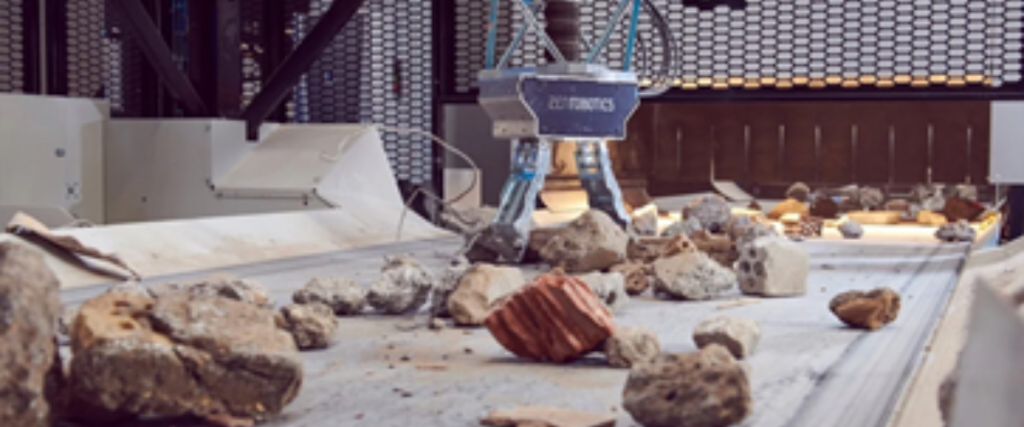
Caption: Robots equipped with artificial intelligence sort construction waste to recover reusable materials.
Artificial intelligence is transforming the way buildings are designed, constructed, and operated by optimizing resources, reducing waste, and improving efficiency throughout a project’s entire life cycle. In light of this evolution, Saint-Gobain Imptek explains how this technology has become a strategic ally for architects, engineers, and builders by enabling more precise decisions that drive more sustainable construction and prepare the industry to meet today’s challenges.
Every construction project begins with a decision: how to build better while using fewer resources. Faced with this challenge, artificial intelligence (AI) is beginning to establish itself as a tool capable of transforming every stage of the construction process. Far from replacing the work of architects, engineers, and builders, it enables the analysis of large volumes of data to make faster, more accurate, and more sustainable decisions. For Saint-Gobain Imptek, this technology represents an opportunity to build more efficiently and meet the industry’s new demands.
“Artificial intelligence does not replace the experience of those who build; it enhances it. Its greatest contribution is helping to make better use of resources and accelerate more efficient and sustainable construction,”, said Silvia Andino, Marketing Manager at Saint-Gobain Imptek.
From Design to Construction: Smarter Decisions
The transformation begins before the first material is installed. Thanks to AI, it is possible to evaluate thousands of alternatives to optimize lighting, ventilation, energy consumption, and material use, making it possible to develop more efficient projects right from the design stage.
An example of this occurred in Toronto, Canada, where Autodesk used generative artificial intelligence to analyze more than 10,000 configurations in the design of its offices, cutting weeks of work down to just a few days and creating more functional spaces for its employees.

Caption: Autodesk used artificial intelligence to analyze more than 10,000 configurations and optimize the design of its offices in Toronto
More Productive and Sustainable Buildings
During construction, AI also helps coordinate schedules, anticipate delays, optimize the supply of materials, and detect errors before they lead to cost overruns. This not only improves productivity but also reduces waste and enhances worker safety.
In Switzerland, for example, the company ZenRobotics uses robots equipped with artificial intelligence to sort up to 200 metric tons of construction waste per hour, recovering materials that are reused in new projects and strengthening the circular economy.
Buildings That Use Less Energy and Last Longer
The potential of artificial intelligence extends beyond the completion of construction. Through sensors and predictive analytics, buildings can optimize their energy consumption, anticipate maintenance needs, and improve comfort for their occupants. In addition, this technology makes it easier to identify reusable materials when a building reaches the end of its useful life, promoting an increasingly circular approach to construction.
For Saint-Gobain Imptek, the adoption of these tools represents an opportunity to address the industry’s key challenges: building more efficiently, reducing environmental impact, and making better use of every resource. Artificial intelligence does not replace human talent; it complements it to enable more resilient, future-ready construction.
Today, the construction industry faces the challenge of doing more with less: optimizing resources, reducing its environmental impact, and creating spaces that better meet people’s needs. In this regard, artificial intelligence is beginning to establish itself as a tool thatthat complements—rather than replaces—the expertise of designers and builders. Its true value lies in helping to make better decisions to develop buildings that are more efficient, sustainable, and prepared for the challenges of the future.
About Saint-Gobain:
A global leader in lightweight and sustainable construction, Saint-Gobain designs, manufactures, and distributes materials and services tailored to the residential, non-residential, and infrastructure markets. Its integrated and innovative solutions provide sustainability, performance, and well-being to its customers. The Group is guided by its purpose: “MAKING THE WORLD A BETTER HOME.”
- €46.5 trillion in sales in 2025
- 162,000 employees, operations in 80 countries
- Committed to achieving zero net carbon emissions by 2050
For more information about Saint-Gobain, visit us at: http://www.saint-gobain.com/ and follow us on LinkedIn: Saint-Gobain
About Imptek:
Imptek-Chova del Ecuador S.A. is an Ecuadorian company belonging to the Saint-Gobain Group with 45 years of experience in the waterproofing, road construction, and light construction markets .
Its commitment to quality and innovation, its implementation of processes, its national and international certifications, its qualified staff, and its environmentally responsible practices are just some of the reasons why it ranks among Ecuador’s 1,000 most important companies. Since 2021, it has been certified as a Great Place to Work to Work. Imptek has been exporting its products for 30 years to more than 8 countries in Latin America
- 18 million in sales in 2024
- 100 employees, locations in 1 country
- Committed to achieving carbon neutrality by 2050